
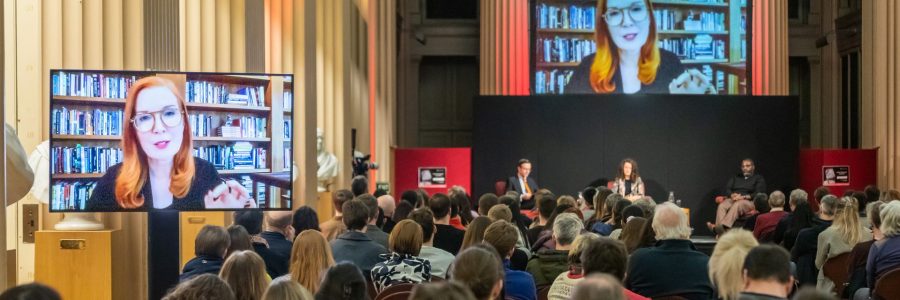
Edinburgh Futures Conversations – The Future of Artificial Intelligence: Shaping our AI Futures is the first event in Love Machine, the Edinburgh Futures Institute’s Spring 2023 programme of events. The season explores the interconnections of Artificial Intelligence and data with humanity through conversations, performances, and workshops. The Future Institute’s event season takes place alongside the University’s celebration of 60 years of computer science and AI research.
In this thought piece, Gregor McElvogue from the School of Informatics reflects on the Future Conversation’s theme: Shaping our AI futures.
In 1963, a future was imagined at 4 Hope Park Square, Edinburgh, by the newly funded Experimental Programming Unit. The Unit grew over decades, mergers and reorganisations to become today’s School of Informatics, where futures are still being imagined. However, sixty years ago, this small research group, led by Donald Michie, a member of the code-breaking group at Bletchley Park and a colleague of Alan Turing, imagined a future where, “householders would one-day tap information from computers in the same way that they could draw water, gas or electricity”[1]. The same imaginations also had a sense of irony; they called their first experiment in machine learning MENACE (Matchbox Educable Noughts and Crosses Engine). Their imagined futures are our everyday present.
Imagining the future
Our imaginations are where our possible futures are born. A future we can imagine is a future we can build, and what we build becomes how we live. Personal communicators, whether from Star-Trek or Dick Tracy, are here. HG Wells and Jules Verne imagined humans on the moon decades before Apollo. Wells also imagined lasers and nuclear weapons. A possible future where planetary systems threaten our existence is already uncomfortably close to becoming our present, so which possible futures we choose to build is worth some pause.
What other futures are we imagining? Are these futures we’d choose to live in? Do we want to live sedentary, comfortable lives drifting through the cosmos in a fully automated spaceship, needing a garbage robot to become our saviour? Or a future where the rise in global temperature supercharges fungal evolution and humans are terminals in an intelligent mycelia network? Perhaps we’d rather live in a future where we make the machines, connect them, and then let them think. We have imagined these and other futures, vicariously living them projected large, like shadows in a cave. And if we build them, they will come.
ChatGPT: A view of the future?
However, when we imagine our future, when we can see it, we help narrow our choices. Imagined futures help us see a little farther, so we can navigate what lies ahead. We may avoid choosing to build a dystopian future if we scare ourselves enough by imagining it first. Turing imagined a child computer that, like Pinocchio, would dissemble so well that we’d believe it to be human. Was Turing’s child a cautionary tale rather than instructions for what should come?
Some propose that ChatGPT is Turing’s child: it does dissemble, or “hallucinate” in the latest term of art for assembled fiction. ChatGPT can fool us into feeling that there is an entity behind the words, one that is interacting with us, doing its best to give us what we asked for, sometimes overly enthusiastically. It can feel like chatting with a precocious child, albeit with access to vast amounts of content and a penchant for invention. Is ChatGPT little more than a scaled-up version of magnetic poetry: words stuck to a refrigerator door waiting to be arranged into infinite sentences?
Whichever way we categorise it, ChatGPT is no longer an imagined future. It is our present, a future we have chosen and built. Another word arranger (born 400 years before the futurists entered 4 Hope Park Square) invented, or at least first recorded, more than 1,700 words. ChatGPT can reorder, reuse, and renew Shakespeare’s words…but like Mark Twain, it can also “manufacture seven facts out of whole cloth.” In doing so, ChatGPT may create fiction but cannot go where no one has gone before: it cannot imagine. Or am I whistling in the dark?
Not according to the distinguished panel at last night’s Shaping our AI Futures event in the Playfair Library. The overwhelming message from the stage was that the AI genie is now firmly out of the bottle. Corporate personhood, shareholder value, and competitive forces will inevitably lead to maximising profits at the expense of restraint, fairness and global equity. The issue is not so much how we choose our future but who chooses it for us.
Last night, the most chilling imagined future involved AI befrienders in a commerce-driven metaverse, deceiving unsuspecting human marks into unwanted purchases. Scary. Except deceptive business practices are already illegal in most jurisdictions, as social media influencers have discovered, so why the need to legislate and regulate impersonating a human? Perhaps because we fear an AI avatar would be better at deception than we are. We are social beings, and that makes us vulnerable to natural and artificial scam artists. When we eventually get to the boss level in Turing’s Imitation Game, even the experts expect the AI to win and, by fooling us, prove to be the more intelligent player.
 Gregor McElvogue is a Business Development Manager in the School of Informatics and programmer for Imagining Futures: AI on Film, part of a year-long celebration marking sixty years of research into computer science and AI at the University of Edinburgh.
Find out more about the University’s celebration of 60 years of computer science and AI
View the full programme of Love Machine: Spring 2023 event season